
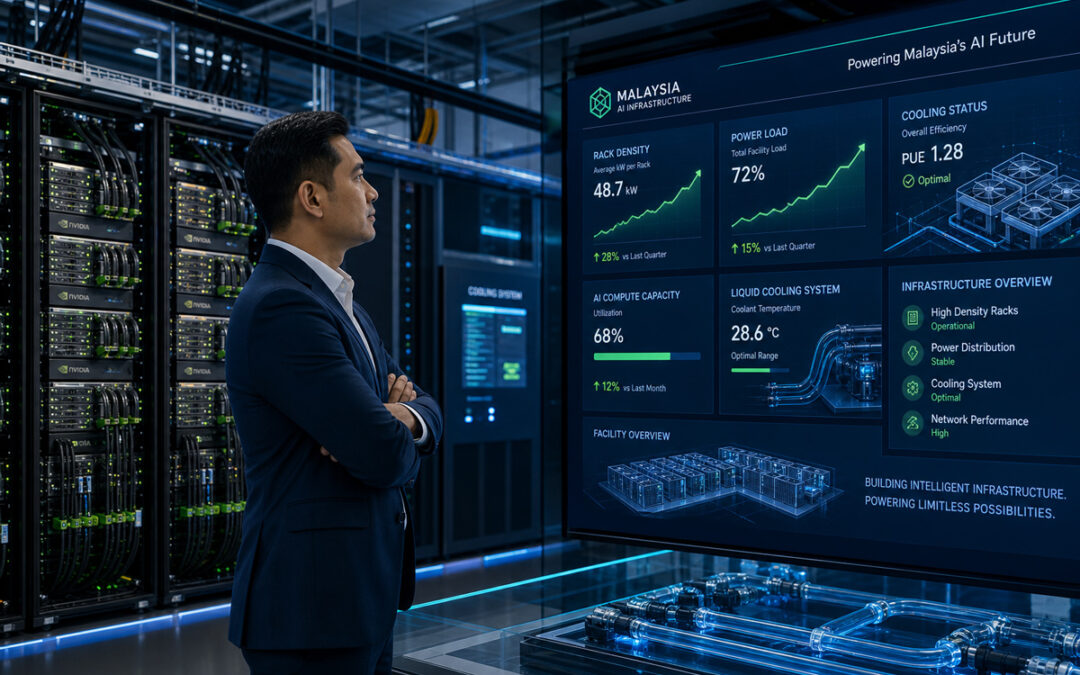
Why AI Growth Is Changing Rack Density, Power, and Cooling
“AI is not only changing software. It is changing the physical demands placed on infrastructure.”
When many business leaders hear the word AI, they think about automation, analytics, copilots, or business applications.
Those are the visible parts.
The less visible part is what AI is doing to infrastructure.
Across the global data center market, AI is increasing compute intensity, which in turn is changing rack density, power demand, cooling design, and facility planning. JLL’s 2026 Global Data Center Outlook says AI is fundamentally reshaping facility design, with AI training environments requiring roughly 40 to 100+ kW per rack and often needing liquid cooling to manage the heat. Uptime Institute also says operators are expanding and modernizing to meet higher power and density requirements, while dealing with rising costs and worsening power constraints.
Source: JLL
What rack density means in simple business language
Rack density refers to how much power is used in a single rack of IT equipment.
As compute demand rises, more processing power is packed into the same physical footprint. That creates more heat and places more pressure on power delivery and cooling systems. Uptime Institute says average rack density continues to rise, with growth especially visible in the 10 kW to 30 kW range, while some high-density environments now exceed 30 kW and, in AI-focused cases, can go far beyond that. JLL’s outlook adds that AI training clusters often sit in the 40 to 100+ kW per rack range.
Source: Uptime Intelligence
Why AI is pushing infrastructure so hard
AI workloads are different from many traditional business applications.
They demand more concentrated compute, which means:
-
- Higher power draw per rack
- Greater heat output
- More demanding cooling methods
- Stronger electrical planning
- More disciplined facility design
JLL says next-generation AI is changing location strategy and facility design because high-density AI environments need more power and more advanced cooling. Uptime Institute adds that operators modernizing for AI must address availability, efficiency, staffing, supply chain delays, and unpredictable technological advances.
Source: JLL
Why cooling is becoming a bigger issue
Traditional air cooling is still common for lower-density environments, but AI is pushing parts of the industry toward more advanced thermal management.
JLL says high-density AI racks often require liquid cooling because conventional air-cooled designs may not handle the heat efficiently enough. Uptime Institute also says perimeter cooling remains common for traditional low-density workloads, but for high rack power above 50 kW or specialized high-performance IT, liquid cooling is typically used.
Source: JLL
For business readers, the message is simple:
As workloads become more demanding, the surrounding environment matters more.
Why power is now part of the strategy conversation
Power used to be something many businesses assumed would “just be there.”
That assumption is getting weaker.
Uptime Institute says the industry is facing worsening power constraints, and JLL notes that AI demand is driving major changes in design and location because suitable power capacity is harder to secure. Uptime also highlights that high-density compute can create larger power swings and surges, which raises the bar for electrical planning in advanced environments.
Source: Uptime Institute – Journal
This matters because if power becomes a constraint, it affects more than IT performance. It affects scalability, uptime planning, and future readiness.
Why this matters even if your business is not building AI clusters
Many Malaysian SMEs and corporates are not planning their own AI training data centers.
But that does not mean this trend is irrelevant.
The AI wave is changing how the broader infrastructure market thinks about:
-
- Power planning
- Cooling discipline
- Facility readiness
- Hardware density
- Upgrade paths
- Long-term capacity
JLL says AI is accelerating demand across the sector and changing how facilities are designed. Uptime Institute’s 2025 survey also shows that the need to modernize for power and density remains strong, even though extreme AI densities are still rare in most enterprise environments today.
Source: JLL , Uptime Intelligence
So even if a business is only adopting AI tools gradually, the infrastructure world around it is already changing.
What this means for office server rooms and older environments
Older server rooms and smaller in-house environments were often built for lower-density, less demanding workloads.
That can become a problem as businesses add:
-
- More virtualized workloads
- Larger data sets
- Heavier application stacks
- AI-assisted platforms
- More always-on services
JLL notes that semiconductors and high-powered chips are consuming more power and generating more heat, which affects rack densities, cooling requirements, and design expectations even beyond specialized AI facilities. That makes it harder for older or lightly managed environments to keep pace.
Source: JLL
Where colocation fits
Colocation becomes more relevant when a business needs a stronger environment for growing compute and infrastructure demands, without taking on the full burden of building and maintaining that environment itself.
A professionally managed colocation facility is better positioned to support:
-
- Stronger power design
- Better cooling discipline
- More resilient infrastructure
- Clearer upgrade paths
- Better readiness for future workload growth
BigBand’s public positioning emphasizes Tier III infrastructure, 99.982% uptime, precision cooling, UPS-backed power, and secure control for business-critical systems in Malaysia. That aligns well with the broader market shift toward more demanding infrastructure conditions.
Source: Uptime Institute
BigBand’s advisory view
At BigBand, we believe AI should be understood not only as a software opportunity, but as an infrastructure signal.
Even if a business is not deploying advanced AI workloads today, the direction is clear. Compute is becoming denser. Power planning matters more. Cooling matters more. Facility discipline matters more.
That is why infrastructure decisions should be made with future workload growth in mind, not only current conditions. BigBand’s role is to help businesses assess whether their present environment can still support tomorrow’s demands, and whether colocation, cloud, or a hybrid strategy will provide a stronger path forward.
Final thought
AI growth is changing rack density, power, and cooling because it is changing what infrastructure must carry.
For businesses, the lesson is not that every company needs an AI data center.
The lesson is that infrastructure expectations are rising, and the environments supporting critical systems need to rise with them.
If your business is reviewing whether its current environment can support heavier workloads, future AI adoption, or more demanding infrastructure needs, BigBand can help you assess whether colocation, cloud, or a hybrid model is the better fit for continuity, control, and future readiness.