
No System, No Invoice, No Payment: Is Your Cash Flow One Breakdown Away from Stopping?
In short: with e-invoicing, issuing an invoice in Malaysia now depends on your system and your internet working at the moment you bill. If either stops on the wrong day, invoices wait, customers’ payment cycles move on without you, and cash arrives weeks late. The fix is not complicated: a backup internet line, a billing system that does not live on one office computer, and a safe copy of your records at a second site.
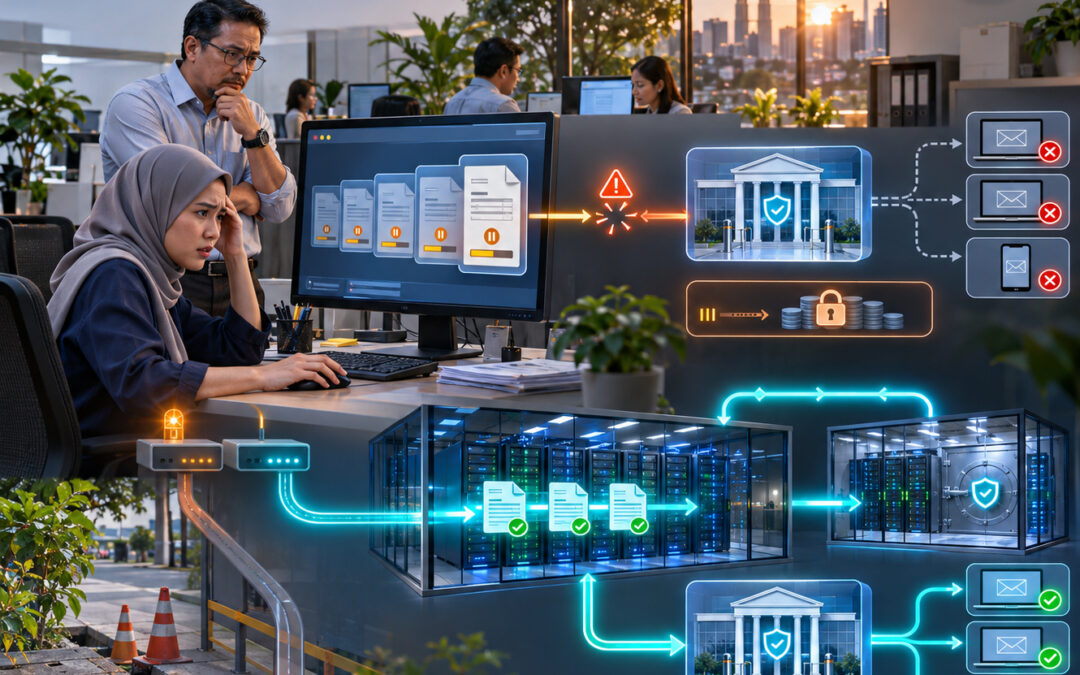
It is the last working day of the month, 4:30 in the afternoon. Your accounts clerk has 40 invoices ready to go. Your biggest customer only processes supplier invoices received before month end. Then the office internet goes down.
Nobody did anything wrong. A contractor cut a cable down the road. By the time the line comes back the next morning, your customer’s cut-off has passed. Those invoices now join next month’s payment run. The goods were delivered on time. The money arrives 30 days late.
Billing is now a live system
By 1 October 2026, more than 268,000 taxpayers had submitted 1.99 billion e-invoices to LHDN through MyInvois. Each one is checked and validated electronically before your customer receives it. Businesses with annual revenue of RM3 million and above are now in the system, and the newest group has a relaxation period until 31 December 2027, subject to LHDN’s conditions.
That changes what an invoice is. It used to be a piece of paper you could print, sign and send whenever you liked. Now it is a record that has to travel from your system, over your internet line, to LHDN and back. Failing to issue an e-invoice when required can mean a fine of RM200 to RM20,000 for each offence.
Three ways the chain breaks
First, your internet line. Most small offices run on a single broadband connection. One cable cut, one faulty router or one area outage, and nothing leaves the building: no e-invoices, no emails, no online banking.
Second, the computer your billing runs on. In many SMEs, the accounting system sits on one desktop or a small server in the corner. A power trip, a failed hard disk or a ransomware attack, and your invoices, customer records and history are out of reach until someone fixes it.
Third, the online services you depend on. On 12 and 13 November 2026, a global Microsoft outage disrupted Outlook, Teams and other Microsoft 365 services for more than 12 hours, reaching Asia-Pacific business hours. Malaysia’s National Cyber Security Agency, NACSA, advised affected organisations to check their systems. Any business that sends invoices or payment reminders only through Outlook felt it.
One detail many owners miss
LHDN’s e-invoice guideline includes a section on what happens when the MyInvois system itself is disrupted: taxpayers who can show evidence of their compliance efforts are assessed case by case. That covers LHDN’s side. There is no equivalent safety net when the breakdown is on your side, in your own internet line or your own computer. Keeping your billing running is your responsibility.
“AI does not fix messy information. It repeats the mess faster, in front of your customers.”
BigBand Advisory
Is your billing ready for a bad day?
- If your office internet went down at 4:30pm on the last working day of the month, could you still issue invoices?
- Does your accounting or billing system run somewhere other than one computer in the office?
- Is there a backup copy of your invoices and customer records at a second location?
- If your email service stopped for a day, do you have another way to send invoices and reminders?
- Do you know how long it would take to restore your billing system if that computer failed today?
If you answered “no” or “not sure” to two or more, your cash flow depends on luck more than it should.
What to do before the next month end
- Add a second internet line from a different provider or on a different path, so one cable cut does not stop billing.
- Move your accounting and billing system off the office desktop into a professional data centre, where power and cooling are built to stay on.
- Keep a backup copy of invoices and customer records at a second site, and test that you can restore it.
- Agree a simple plan B with your accounts team: who issues invoices, from where and how, if the office is offline.
Keep your cash moving. Talk to BigBand
BigBand is a Malaysian digital solution provider serving businesses from six data centres in Cyberjaya, Brickfields, Nusajaya and KL City. We can run your billing and accounting system in a professional data centre, keep a backup copy in a second BigBand location, and connect your office with business internet and a backup line, so month end is just another working day.
As your trusted digital solution provider, we will walk through your billing setup with you and show you where it could break, in plain language. Call +60 3 5879 3933 or visit bigband.net.my.
Frequently asked questions
Q: What happens if my internet is down when I need to issue e-invoices?
A: Invoices cannot be submitted to LHDN for validation until your connection returns, so customers may receive them late and pay later. LHDN’s guideline on disruptions covers outages of the MyInvois system itself, not problems with your own internet or computers.
Q: How can a small business keep e-invoicing running during an outage?
A: Use a backup internet line, host your billing system in a professional data centre rather than on one office computer, and keep a tested backup of your invoices and customer records at a second site.
Q: Do all Malaysian businesses need to issue e-invoices?
A: Businesses with annual revenue below RM3 million are generally exempt, subject to LHDN’s criteria. Check the latest LHDN guidance to confirm your obligations.
BigBand is your business continuity partner.
Stay Connected. Stay Protected. Stay Running.
+60 3 5879 3933 | [email protected]