
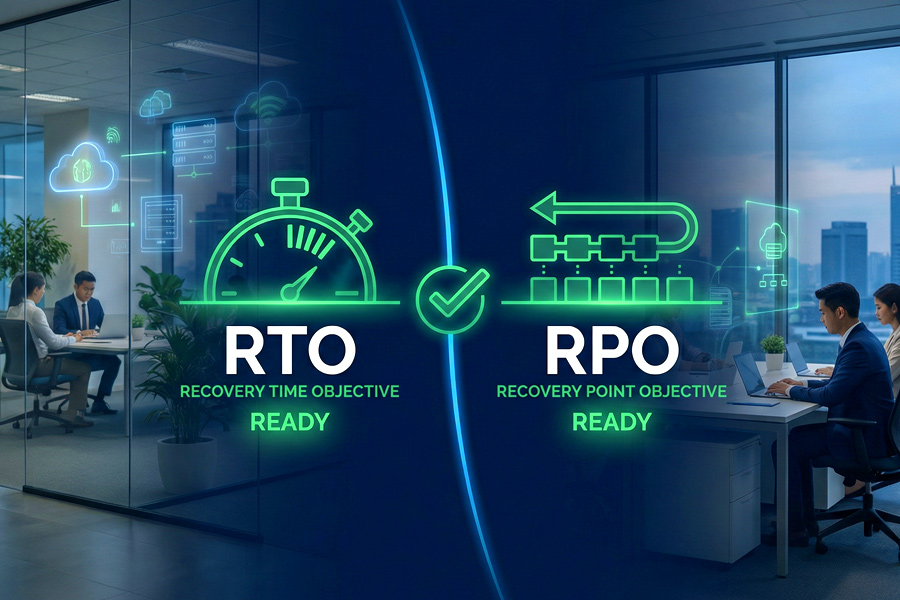
Two Numbers That Determine Whether
Your Business Survives a Crisis
RPO and RTO explained in plain business language, with a practical guide to setting your targets and a recovery comparison that shows exactly what is at stake.
The Two Questions Every Business Owner Should Be Able to Answer
Imagine your business systems go completely offline right now. Maybe it is ransomware. Maybe it is a hardware failure, a flood in your server room, or a critical configuration error. However it happened, your operations are down.
Two questions determine what happens next. First: how long can your business function before the damage becomes truly serious? An hour? Four hours? A day? Second: how much data can you afford to lose? The transactions from the last hour? The last day? The entire week?
These are not IT questions. They are business questions. And the answers, expressed as two numbers called RPO and RTO, are the foundation of every meaningful backup and disaster recovery plan. Most Malaysian businesses have not formally answered them. This post explains what they mean, why they matter, and how to set targets that reflect what your business actually needs.
WHY THIS MATTERS MORE IN 2026 THAN IT DID FIVE YEARS AGO
Average ransomware downtime globally remained close to 24 days across industries in 2025, according to ransomwarehelp.com’s January 2026 analysis. That is nearly a month of operational disruption. Yet organizations using automated recovery playbooks and defined recovery objectives contained breaches in a median of 51 days, compared to 79 days without them. The difference, roughly four fewer weeks of disruption, comes from preparation, not from a different attack.
Source: ransomwarehelp.com
For Malaysian businesses specifically, Simply Data’s Malaysia Cybersecurity Landscape 2026 report confirms a stark contrast: businesses without tested recovery plans take 14 to 21 days to restore full operations after a ransomware incident. Businesses with documented, tested recovery plans with clearly defined targets restore operations in 2 to 5 days. At RM 50,000 to RM 100,000 in daily revenue loss, the difference between 5 days and 21 days of downtime is between RM 750,000 and RM 1.6 million in lost revenue, before accounting for recovery costs, customer penalties, and PDPA regulatory exposure.
Source: simplydata.com.my
RPO and RTO: The Two Numbers, Explained Simply
These two terms have been described in complex technical language for too long. Here is what they actually mean for your business:
RTO (Recovery Time Objective)
How long can your business afford to be offline?
RPO (Recovery Point Objective)
How much data can your business afford to lose?
The question it answers: If a disaster happened right now, how far back can we restore our data before the loss becomes unacceptable?
Example: If your RPO is 4 hours, your backup system must capture a clean copy of your data at least every 4 hours. If a ransomware attack hits at 3pm and your last backup was at 11am, you lose 4 hours of transactions, updates, and records. Whether 4 hours of data loss is acceptable depends entirely on your business. For a hospital managing patient records, even 30 minutes is too much. For an internal document archive, 24 hours might be fine.
“RTO and RPO are not just IT metrics. They are business decisions with financial consequences. A business that has never formally set them has implicitly accepted whatever RTO and RPO its current backup system happens to deliver, which is almost always far worse than what the business would choose if asked.”
Expert Insights: RTO and RPO Explained, Defining Recovery Requirements (February 2026) | Source: expertinsights.com
What Happens to Malaysian Businesses Without Defined RPO and RTO Targets
The Expert Insights February 2026 analysis of disaster recovery practices makes a finding that should concern every Malaysian business owner: only 20% of organisations describe themselves as fully prepared for outages, and 71% do not perform failover testing at all. Most organisations either set recovery targets they never validate or skip defining them entirely.
Source: expertinsights.com
The practical consequence is straightforward. When a ransomware attack, hardware failure, or any other major incident occurs, a business without defined recovery targets faces three compounding problems. First, no one knows which systems are the highest priority to restore. Second, no one knows what ‘success’ looks like in the recovery effort, meaning recovery drags on longer than necessary. Third, when the recovery is finally complete, there is no way to know whether the data that was restored is actually complete, because there was no target to measure against.
For Malaysian businesses, the regulatory dimension matters additionally. Malaysia’s PDPA requires that businesses can demonstrate appropriate safeguards for the integrity and availability of personal data. A business that has never defined its recovery objectives cannot demonstrate that it has implemented appropriate safeguards, because ‘appropriate’ requires a benchmark to measure against.
The Financial Case for Knowing Your Numbers
The table below uses a representative Malaysian SME with RM 50,000 in daily revenue to illustrate what defined versus undefined recovery objectives mean financially. The same logic applies at any scale.
How to Set Your RPO and RTO: A Practical Starting Point
Setting RPO and RTO targets is a business conversation, not a technical one. It begins with a simple question for each of your critical systems: if this goes down completely, what is the maximum amount of time we can be without it before it starts costing us money, customers, or compliance standing?
Microsoft’s Azure reliability documentation provides a clear framework: for each critical system, business unit leaders and senior management must assign the best-case recovery scenarios they find acceptable for RTO (downtime tolerance) and RPO (data loss tolerance). The answers drive all subsequent technical decisions about backup frequency, infrastructure design, and recovery testing schedules.
Source: learn.microsoft.com
The table below provides suggested starting targets for different types of Malaysian businesses, based on Expert Insights’ recovery tiering framework (February 2026) and the Veeam blog’s RPO and RTO guide (January 2026). These are starting points for discussion, not universal rules. Your actual targets depend on your specific business model and revenue patterns.
Sources: expertinsights.com and veeam.com
Veeam’s January 2026 RPO and RTO guide makes an important practical point: not every system in your business needs the same targets. Mission-critical systems, those directly facing customers or generating revenue, need aggressive targets. Internal or archival systems can tolerate longer recovery windows at significantly lower cost. Applying a one-size-fits-all approach either overspends on protection for low-value systems or underprepares for the ones that matter most. Source: veeam.com
THREE QUESTIONS TO ASK YOUR IT TEAM OR SERVICE PROVIDER THIS WEEK
Question 1: What is our current Recovery Time Objective for our most critical system? Is that number written down, or is it an estimate?
Question 2: What is our current Recovery Point Objective? How often are our backups actually capturing data, and when was the last time we tested a restore?
Question 3: If we experienced a major incident tomorrow, which systems would we restore first, second, and third, and does our current backup architecture actually support that priority order?
If the answers to any of these questions are uncertain, vague, or involve estimates rather than documented targets, that is your starting point. The goal is not to achieve perfect RTOs overnight. It is to have honest numbers that your backup and recovery plan is actually built to deliver.
Source: Expert Insights, February 2026 and Microsoft Azure reliability documentation.
A Final Word
We encourage every Malaysian business owner to review their recovery objectives with their current IT adviser or service provider. Use the three questions above as a starting point. Ask for your current RTO and RPO in writing, not as estimates. Ask to see the results of the last backup restore test. Ask which systems are prioritised in your recovery sequence. These are reasonable, professional conversations that any qualified IT partner should welcome.
If you would like a second perspective, or if you are evaluating your options and want an independent review of whether your backup and recovery plan will actually deliver your target RTO and RPO, BigBand is happy to offer a no-obligation conversation. We are not here to replace your current provider. We are here to help make sure your business can recover as fast as it needs to, when it needs to.
bigband.net.my/bigband-contact | Office: +60 3 5879 3933 | email: [email protected]