
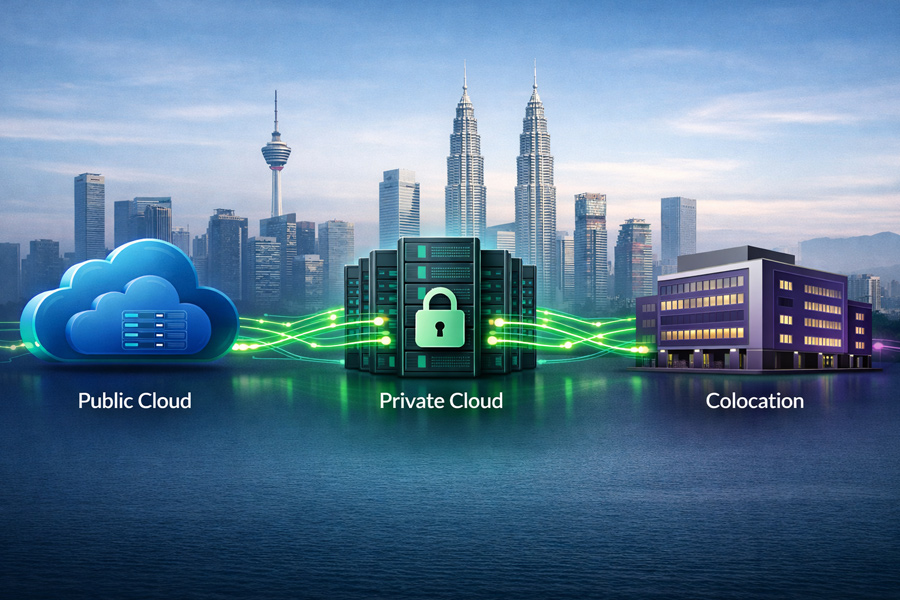
Which Infrastructure Model Is Right
for Your Malaysian Business?
A plain-language guide to public cloud, private cloud, and colocation in 2026, what each model does well, where it falls short, and how to place each workload where it belongs.
The Question Has Changed. The Answer Is More Useful.
A few years ago, the infrastructure conversation for most Malaysian businesses was binary: move to the cloud, or stay on-premises. In 2026, that framing is obsolete. The more mature and more useful question is not which model to pick, but which workloads belong where.
Gartner named hybrid computing as the number one infrastructure trend for 2026 at its IT Infrastructure, Operations and Cloud Strategies Conference in December 2025. Gartner defines hybrid computing as orchestrating across diverse compute, storage, and network mechanisms, not choosing one and abandoning the others. The same research organisation predicts 90% of organisations will adopt a hybrid cloud approach through 2027. Gartner also projects that 25% of organisations will experience significant dissatisfaction with their cloud adoption by 2028, not because cloud is wrong, but because workloads were placed in the wrong environment without enough thought about cost, control, and compliance.
Sources: gartner.com
This post explains what each model actually does well, where each falls short, and gives you a practical workload placement framework you can use in your next infrastructure conversation. For Malaysian businesses, it also covers the specific data sovereignty and compliance considerations under PDPA and the Cybersecurity Act 2024 that affect where certain data can and cannot live.
MALAYSIA’S INFRASTRUCTURE CONTEXT IN 2026
Malaysia is one of Southeast Asia’s fastest-growing cloud and data centre markets. The Malaysia Digital Transformation Market was valued at USD 10.68 billion in 2025 and is projected to reach USD 29.74 billion by 2031, with cloud deployment leading at 70% revenue share and growing at a 19.74% CAGR as businesses accelerate migration from on-premises systems, according to Mordor Intelligence. Microsoft launched its Malaysia West cloud region in 2025 with three availability zones. AWS is advancing its Malaysian presence. Johor alone has approximately 4.0 GW of data centre capacity under development.
This expansion means Malaysian businesses in 2026 have genuinely world-class options across all three models: public cloud from global hyperscalers now available in-country; managed private cloud from specialist providers; and Tier III colocation in professionally operated facilities. The choice is no longer constrained by what is available. It is a question of what is right for each workload.
Source: nexdigm.com
The Three Models: What Each One Actually Does
Here is a plain-language summary of each model, what it is designed for, where it excels, and where it creates problems if the wrong workloads are placed in it.
PUBLIC CLOUD Agility at scale
PRIVATE CLOUD Control at scale
Best for: Compliance-sensitive or regulated workloads, financial transaction systems, healthcare data, systems requiring data residency guarantees, workloads with predictable and consistent demand, environments where multi-tenant risk is not acceptable.
Strength: Dedicated infrastructure used exclusively by your organisation. Full control over configuration, segmentation, and security. Data residency is absolute and demonstrable. Predictable monthly costs with no surprise bills or egress fees. Strong SLAs with direct escalation. Better suited than public cloud for organisations where a hyperscaler outage would be catastrophic.
Watch for: Higher baseline cost than public cloud for low-utilisation periods. Requires more upfront planning. Scaling up quickly requires lead time. Not the right model for bursty, experimental workloads where you need to provision and de-provision rapidly.
Source: concourse-cloud.com
COLOCATION Your hardware, world-class facility
Best for: Businesses with existing hardware investments, workloads requiring specialised or proprietary hardware, AI and GPU-intensive processing, businesses seeking predictable infrastructure costs with Tier III uptime guarantees, hybrid deployments where own hardware connects to cloud via Direct Cloud Connect.
Strength: Your own hardware in a professionally managed facility Tier III uptime, 24/7 security, precision cooling, redundant power, carrier-neutral connectivity. Eliminates the capital expenditure of building and maintaining a server room. Provides direct cloud on-ramps for hybrid connectivity. Increasingly used for GPU clusters and AI workloads where hyperscaler GPU pricing is prohibitive for sustained use.
Watch for: You own and manage the hardware, meaning refresh cycles and hardware failures remain your responsibility. Slightly less flexible than cloud for rapid provisioning of new capacity. Physical access to hardware requires visiting the facility or using remote hands services.
“Hybrid computing is an emergent style that orchestrates across diverse compute, storage, and network mechanisms. I&O leaders must be aware of this trend and prepare to act on it. The era of ‘all public cloud’ is giving way to deliberate workload placement across environments.”
Jeffrey Hewitt, VP Analyst, Gartner | Gartner IT Infrastructure, Operations and Cloud Strategies Conference, December 2025 | Source: gartner.com
The Practical Workload Placement Guide for Malaysian Businesses
The most useful infrastructure question is not ‘which model should we use?’ but ‘which model should this specific workload use?’ The table below applies this thinking to the most common workload types in Malaysian SMEs and organisations. BEST means this is the natural home for this workload. GOOD means it works well here. A dash means it can be done here but usually is not the optimal choice.
The Malaysian Compliance Dimension: Data Sovereignty and PDPA
For Malaysian businesses, the infrastructure decision carries a specific regulatory dimension that does not apply in all markets. Malaysia’s Personal Data Protection Act (PDPA) requires businesses to take reasonable steps to ensure personal data is protected, including considerations about where that data physically resides and who has access to it.
PDPA and Data Sovereignty: What Malaysian Businesses Need to Know
Public cloud environments from global hyperscalers technically route and store data in international data centres unless Malaysian regional availability zones are specifically configured and data residency settings are explicitly applied. For most business applications this is configurable, but it requires deliberate action, not default settings.
Microsoft’s Malaysia West cloud region and AWS’s Malaysian availability zones both launched or advancing in 2025 make public cloud PDPA-compliant data residency achievable for the first time at scale in Malaysia. However, businesses in regulated sectors such as financial services (subject to BNM RMiT guidelines) and healthcare may still prefer private cloud or colocation as the cleaner compliance story: data demonstrably stays in Malaysia, on infrastructure you control, with full audit traceability.
Source: news.microsoft.com
The Cybersecurity Act 2024 additionally requires organisations classified as Critical Information Infrastructure operators to maintain active security controls and incident reporting. For these organisations, private cloud or colocation with dedicated security architecture is often the infrastructure model that most straightforwardly meets these requirements.
What Hybrid Infrastructure Actually Looks Like for a Malaysian Business
Hybrid infrastructure does not mean running everything everywhere. It means each workload lives in its natural home, connected where needed. Concourse Cloud’s January 2026 analysis describes the mature 2026 hybrid model clearly: one governed private environment for identity and mission-critical workloads, connected to public cloud for elastic and modern services. The goal is to place each workload where it performs best while keeping governance unified.
For a Malaysian SME, a practical hybrid model might look like this: the company’s ERP and financial systems run on private cloud for cost predictability and data control. Customer-facing marketing assets and the company website run on public cloud for global performance and elastic scaling. AI or data-processing workloads that require GPU compute run in colocation on owned hardware. Backup and disaster recovery targets are set to public cloud storage for low cost and geographic redundancy. A Direct Cloud Connect link between the colocation environment and the public cloud provider ensures low-latency, private connectivity between the environments.
The Equinix hybrid infrastructure analysis confirms this pattern is now standard across mature organisations globally: businesses keep sensitive data in private environments while maintaining seamless integration with public cloud services for other workloads, using colocation data centres as the foundation for hybrid infrastructure. Organisations using colocation as their hybrid hub can deploy their private environments adjacent to the public cloud, giving them the flexibility to choose the right infrastructure for each workload.
BigBand Offers the Full Infrastructure Spectrum
One of the practical advantages of working with BigBand is that we offer the complete range of infrastructure options for Malaysian businesses: you are not advised toward one model because that is the only model we provide. The decision is genuinely about what is right for each of your workloads.

Public Cloud
Agility and global scale

Private Cloud
Control and compliance

Storage Cloud
Scalable data at low cost

GPU Cloud
AI and compute workloads

Colocation
Your hardware, our facility
All five options are available from BigBand, backed by more than 20 years of Malaysian infrastructure expertise and 24/7 support. Whether you need a single model or a fully orchestrated hybrid, BigBand can design, deploy, and manage it. Learn more: bigband.net.my
THREE QUESTIONS TO START YOUR INFRASTRUCTURE CONVERSATION
Question 1: For each of our main business systems, do we know where the data physically resides, and have we verified that this meets our PDPA obligations?
Question 2: Which of our cloud workloads run at consistently high utilisation? Have we compared the five-year total cost of running them on public cloud versus private cloud or colocation?
Question 3: Is our current infrastructure adviser able to provide all three options public cloud, private cloud, and colocation without a built-in preference for one?
A Final Word
We encourage every Malaysian business owner and IT leader to review their infrastructure placement with their current provider using the workload placement framework above. Ask where each of your critical systems physically lives. Ask whether that placement was a deliberate decision or a default. Ask what the five-year total cost comparison looks like between your current setup and the alternatives. These are the conversations that lead to infrastructure that genuinely fits your business.
If you would like a second perspective, or if you are evaluating your options and want an independent view of your infrastructure mix, BigBand is happy to offer a no-obligation conversation. We offer the full spectrum public cloud, private cloud, storage cloud, GPU cloud, and Tier III colocation which means we have no built-in preference for any single model. We are here to help you find what actually fits your business.
bigband.net.my/bigband-contact | Office: +60 3 5879 3933 | email: [email protected]