
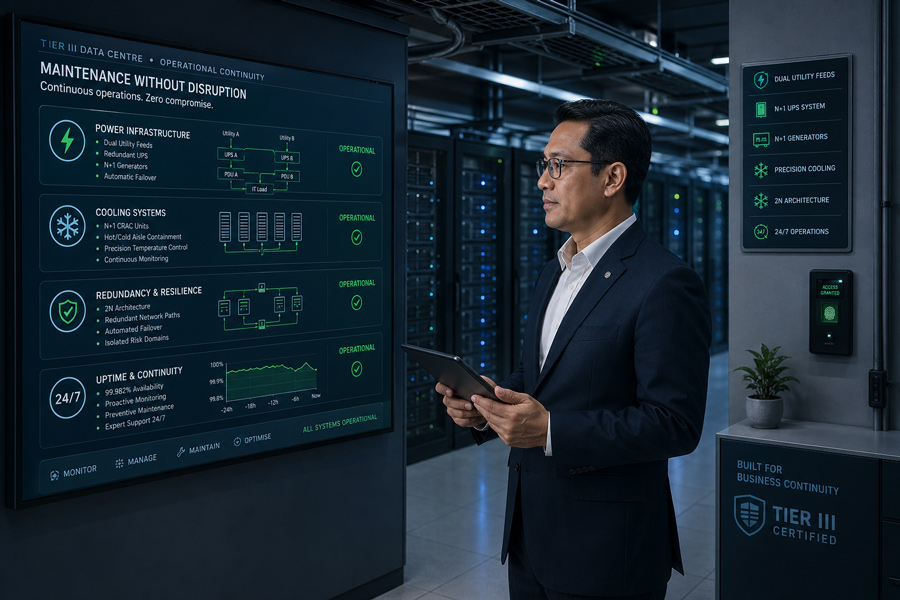
What Tier III Really Means for Business Continuity
“Tier III is not just a technical label. It is a business continuity signal.”
Many businesses see the phrase Tier III data center on a brochure or proposal and assume it simply means “high quality.”
That is not wrong, but it is incomplete.
What matters more is why Tier III matters, and what it means in practical business terms. According to Uptime Institute, Tier classifications are used to align infrastructure investments to business goals, and Tier III specifically means the facility is concurrently maintainable with redundant components and redundant distribution paths, so maintenance or replacement can happen without shutting down IT operations.
Source: Uptime Institute
Why that matters to business
For management teams, the value of Tier III is simple.
It means the infrastructure environment is designed so that planned maintenance does not automatically become business disruption. Uptime Institute explains that unlike Tier I and Tier II, Tier III facilities do not require shutdowns when equipment needs maintenance or replacement.
Source: Uptime Institute
That matters because in real business life, infrastructure still needs servicing. Power systems, cooling systems, UPS modules, generators, and related supporting equipment do not run forever without maintenance. A stronger data center design reduces the chance that ordinary maintenance activity turns into system unavailability.
What Tier III does not mean
Tier III does not mean “nothing can ever go wrong.”
Uptime Institute says Tier III adds concurrent maintainability, while Tier IV adds fault tolerance through multiple independent and physically isolated systems. It also says Tier levels fit different business functions, not that one tier is universally “better” for every situation.
This is important because businesses should not treat Tier III like a marketing badge only. It should be understood as a design standard that supports a certain level of continuity and maintenance flexibility.
Tier III in plain business language
A simple way to explain Tier III is this:
Your business systems can keep running even when parts of the supporting infrastructure are being serviced.
That is valuable for organisations that rely on:
-
- ERP systems
- Finance and accounting systems
- Production coordination tools
- Customer-facing platforms
- Internal file and application services
- Workloads where interruption would affect operations or trust
Uptime Institute states that Tier III incorporates Tier II components and adds the ability for any part to be shut down without impacting IT operation.
Why Tier III matters more as businesses grow
As a business becomes more digital, infrastructure downtime becomes more expensive.
That is why the data center environment matters more than many management teams first assume. Tier III becomes relevant when the business no longer sees its systems as “helpful tools,” but as part of daily operations that must remain available. Uptime Institute explicitly frames Tier classifications as ways to match infrastructure level to business function.
For a small non-critical setup, a lower standard may be acceptable. But for businesses where interruption affects productivity, customer service, revenue flow, or operational control, a stronger environment becomes more meaningful. That is exactly the business logic behind Tier classification.
How Tier III differs from a basic server room
A normal office server room may have:
-
- Basic UPS support
- Standard air conditioning
- Limited redundancy
- Maintenance procedures that require planned downtime
- Infrastructure that depends heavily on in-house workarounds
By contrast, Uptime Institute says Tier III requires redundant components and redundant distribution paths, with no shutdowns needed for maintenance or replacement.
That difference is not just technical. It changes the business conversation from:
“How do we cope when maintenance happens?”
to:
“How do we keep operations running while maintenance happens?”
Why this connects directly to business continuity
Business continuity is not only about disaster recovery after something fails.
It is also about reducing avoidable interruption in normal operations. Tier III supports that mindset because it is built around maintenance flexibility and operational continuity. Uptime Institute also notes that operational sustainability is a second essential component beyond topology, referring to the behaviors and risks that determine whether a data center can meet long-term business goals.
In other words, the infrastructure design matters, but the operating discipline matters too.
That is why a serious Tier III environment is meaningful for businesses that want more than rack space. They want continuity confidence.
Where BigBand fits
BigBand’s public positioning describes its colocation offering as hosting critical hardware in ISO-certified, globally connected Tier III data centers in Malaysia and beyond, with 99.982% uptime, physical security, precision cooling, and UPS-backed power. BigBand also frames this as helping businesses focus on core operations while maintaining maximum infrastructure availability.
Source: bigband.net.my
That matters because it translates the Tier III concept into a business promise:
-
- Stronger uptime discipline
- A more resilient operating environment
- Maintenance without unnecessary service interruption
- Better support for critical business systems
BigBand’s advisory view
At BigBand, we believe Tier III should not be explained as a technical trophy.
It should be explained as a business continuity advantage.
When a business chooses a Tier III colocation environment, it is not simply paying for a more advanced room. It is choosing a setup designed for continuity during maintenance, stronger resilience in daily operations, and a more professional foundation for critical workloads. That is why BigBand positions Tier III colocation as part of a broader digital infrastructure advisory approach, alongside cloud, connectivity, cybersecurity, and business continuity solutions.
Source: bigband.net.my
Final thought
Tier III really means this:
Your infrastructure environment is designed so that maintenance does not automatically become downtime.
For businesses that depend on digital systems every day, that is not a small technical detail. It is a meaningful part of business continuity planning.
If your business is reviewing where to place critical systems, BigBand can help you assess whether a Tier III colocation environment, cloud setup, or hybrid model is the better fit for your continuity, control, and growth needs. BigBand’s colocation approach is built around Tier III infrastructure, uptime, and operational resilience.