
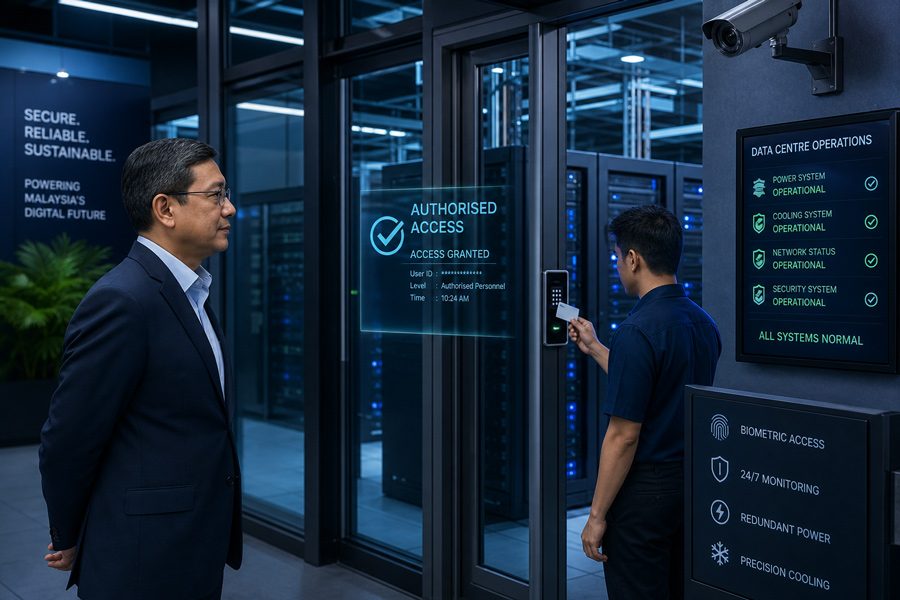
Physical Security Still Matters, Especially for Critical Systems
“A digital system still runs in a physical world. If the physical environment is weak, the business risk is real.”
When businesses talk about protecting systems, the conversation often moves quickly to cybersecurity.
That makes sense, but it can also create a blind spot.
Critical systems do not live in abstract space. They run on hardware, in rooms, inside buildings, supported by power, cooling, access control, and people. Uptime Institute says data center security now has to be understood across physical, human, and digital exposure points, and that operators need to keep reassessing where weaknesses may exist.
Source: Uptime Institute
Why physical security still matters in 2026
Many businesses assume physical security is basic. Lock the room, limit access, and the issue is solved.
But physical security is not just about locking a door.
CISA says comprehensive physical security is part of protecting critical infrastructure, and Uptime Institute notes that physical, human, and digital breach paths are all part of the modern data center risk picture. In other words, physical security is not separate from continuity. It is part of continuity.
Source: CISA
For a business, that means the following question matters:
Who can access the systems, how access is controlled, how the facility is monitored, and how supporting infrastructure is protected.
What physical security really includes
In business language, physical security for critical systems usually involves:
-
- Controlled access to server and infrastructure areas
- Monitored entry and exit procedures
- Restricted handling of critical equipment
- Secure facility design
- Disciplined maintenance and visitor processes
- Protection of supporting systems such as power and cooling
Uptime Institute’s security guidance makes clear that physical data center security is broader than just perimeter protection. It includes infrastructure, procedures, human factors, and the interaction between physical and digital vulnerabilities.
Source: Uptime Institue
Why this matters to business continuity
A weak physical environment can create more than theft risk.
It can lead to:
-
- Accidental disruption
- Unauthorized access
- Delayed incident response
- Equipment interference
- Avoidable downtime
- Loss of management confidence
Uptime Institute also notes that human error remains a major cause of outages, which means physical access discipline and operating procedures matter more than many teams realise.
Source: Uptime Institue Journal
This is why physical security should be seen as an uptime issue, not only a facilities issue.
Why office server rooms are often underestimated
A server room in an office may look secure because it has a door and limited access.
But for critical systems, that is often not enough.
A basic room may not have:
-
- Layered access control
- Formal visitor procedures
- Monitored facility workflows
- Separation between office traffic and infrastructure access
- Professional controls around supporting equipment
Uptime Institute’s physical security research stresses that the scope of security challenges keeps expanding and that operators need to update security processes and continuously test them. That is much harder to achieve in an improvised or lightly managed office environment.
Source: Uptime Institue
Why this matters even more for growing businesses
As businesses become more digital, the value of their infrastructure environment rises.
Systems that support ERP, finance, files, production coordination, customer operations, and internal communications are no longer optional tools. They are operational foundations. CISA’s broader critical infrastructure guidance reinforces the idea that resilience depends on identifying and protecting the assets and environments people and organisations rely on every day.
Source: CISA
That is why physical security becomes more important as a business grows, not less.
Where colocation changes the picture
A professional colocation environment is not only about rack space.
It is also about placing hardware inside a facility designed to protect infrastructure through tighter operational discipline, stronger access control, and a more resilient overall environment. BigBand publicly describes its colocation offering as providing enforced physical security, 99.982% uptime, precision cooling, and UPS-backed power in Tier III data centers.
Source: bigband.net.my
For businesses with critical systems, that changes the question from:
“Can we keep the room locked?”
to:
“Is this environment professionally designed to reduce physical risk to critical operations?”
BigBand’s advisory view
At BigBand, we believe physical security should be discussed in business terms.
It is not just about guards, doors, or camera systems. It is about protecting the environment your operations depend on.
If a business depends on stable systems every day, then physical security becomes part of uptime planning, part of continuity planning, and part of risk protection. That is why BigBand positions physical security together with Tier III infrastructure, precision cooling, and UPS-backed power, not as a side feature, but as part of one professional operating environment.
Source: bigband.net.my
Final thought
Physical security still matters because critical systems still depend on physical environments.
For businesses that take uptime, continuity, and trust seriously, physical protection is not old thinking. It is part of modern infrastructure discipline.
If your business is reviewing where to place critical systems, BigBand can help you assess whether your current environment gives enough physical protection, operational discipline, and continuity support, and whether colocation, cloud, or a hybrid model is the stronger fit for your business.