
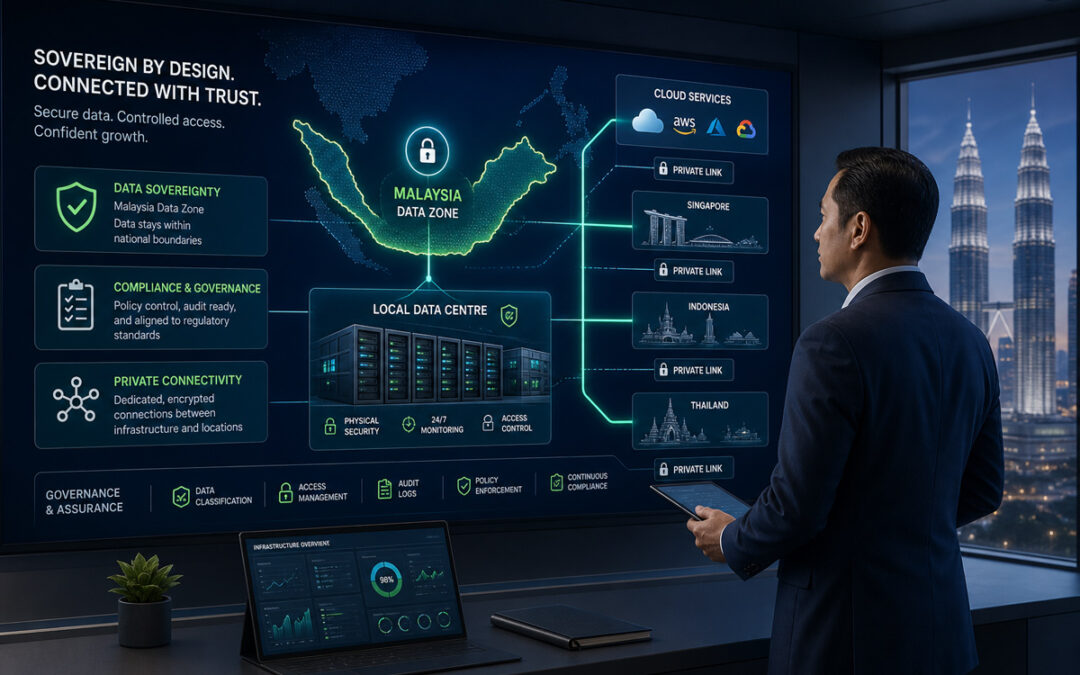
Data Sovereignty, Compliance, and Private Connectivity Explained Simply
“Modern infrastructure decisions are no longer just about where systems run. They are also about where data lives, how it moves, and how much control the business keeps.”
Many business leaders hear terms like data sovereignty, compliance, and private connectivity in discussions about cloud, colocation, and digital transformation.
These terms can sound technical, but the business meaning is actually straightforward.
They all relate to one bigger question:
How do we keep critical systems, sensitive data, and business operations in an environment that is easier to control, easier to govern, and better aligned with business risk?
That question matters more in 2026 because Malaysia’s personal data regime continues to address cross-border data transfers under Section 129 of the PDPA, while regulated sectors such as financial services continue to face detailed technology risk expectations under Bank Negara Malaysia’s RMiT framework.
Source: PDP , PDP – Personal Data Protection Guideline
What data sovereignty means in simple business language
Data sovereignty is about which country’s laws, rules, and legal environment may apply to your data.
For many businesses, this becomes important when:
-
- Customer or employee data crosses borders
- Systems are hosted in another country
- Group companies share data regionally
- Cloud services move or back up data across multiple locations
Malaysia’s Department of Personal Data Protection says Section 129 of the Personal Data Protection Act 2010 regulates the transfer of personal data out of Malaysia, and its cross-border transfer guidance explains how data controllers should assess those transfers.
Source: PDP
So in practical terms, data sovereignty is not just a legal phrase. It affects where a business chooses to host data, how it structures operations, and how confident management feels about governance.
What compliance means in this context
Compliance means making sure your infrastructure, data handling, and operating model align with the rules that apply to your business.
That may include:
-
- Personal data obligations
- Industry regulations
- Internal governance requirements
- Customer expectations
- Contractual obligations
In Malaysia, this matters differently depending on sector. The PDPA guidance is relevant to organizations handling personal data, while Bank Negara Malaysia’s revised RMiT policy document sets out technology and risk management expectations for financial institutions, including areas tied to outsourcing and cloud services.
Source: Bank Negara Malaysia , Bank Negara Malaysia – RMiT
For management teams, compliance is not only about avoiding penalties. It is also about reducing uncertainty and building a more defensible operating model.
What private connectivity means
Private connectivity means a dedicated or more controlled connection between systems, clouds, sites, or partners that does not rely only on the open public internet path.
This matters because the public internet is flexible and widely available, but some workloads need more predictable characteristics.
Equinix says private connectivity is especially valuable when businesses need guaranteed bandwidth, lower latency, and enhanced security, and its colocation connectivity guidance says organizations use a range of networking options in colocation facilities to match workload needs.
Source: EQUINIX – Blog
If you put that into business language, private connectivity helps when a company wants:
-
- More predictable performance
- Better support for business continuity
- Stronger control over critical traffic
- More stable cloud and data center connections
- A cleaner architecture for hybrid environments
Why these three ideas are connected
These concepts are often discussed separately, but in real business planning they usually come together.
For example:
A business may want to keep certain data in Malaysia for governance reasons, place critical hardware in a local colocation environment, and connect private systems to cloud services through more controlled connectivity paths.
That is a combined infrastructure decision, not three separate decisions.
Malaysia’s PDPA cross-border transfer guidance shows why data location and transfer logic matter. Bank Negara Malaysia’s RMiT shows why technology and provider risk matter. Interconnection providers such as Equinix show why private connectivity matters when performance, security, and continuity expectations rise.
Source: PDP , Bank Negara Malaysia , EQUINIX
Why this matters to management teams
Many infrastructure discussions become too technical too early.
A better management view is to ask:
-
- Where is our important data located?
- If data moves across borders, do we understand the implications?
- Are we choosing infrastructure that makes governance easier or harder?
- Are our critical systems depending too heavily on public internet paths?
- Does our architecture support business continuity and customer confidence?
These questions are becoming more relevant because the regulatory and operating environment is not getting simpler. Malaysia’s personal data rules and sector-specific technology risk requirements both point toward more disciplined governance, not less.
Source: PDP , Bank Negara Malaysia
Why this matters to Malaysian businesses
For Malaysian SMEs, corporates, and organizations, these issues matter because infrastructure choices now affect:
-
- Data handling confidence
- Audit readiness
- Customer trust
- Continuity planning
- How easily the business can scale into hybrid models
Private connectivity also becomes more relevant when workloads move between office, branch, colocation, and cloud environments. Equinix’s 2025 guidance specifically presents private connectivity as useful where the internet alone is not sufficient for mission-critical operations and data exchange.
Source: EQUINIX
Why this matters to Chinese and regional businesses
For Chinese speaking companies, manufacturers, and regional businesses entering Malaysia or ASEAN, these topics are often even more important.
They may need to decide:
-
- Whether data should stay local
- How local hosting supports customer or regulator confidence
- How cross-border operations should move data
- How to build a stable Malaysia node that still connects to broader regional systems
Malaysia’s cross-border personal data guidance makes this especially relevant for businesses that move data across countries, while private connectivity becomes useful where firms want better controlled links between local infrastructure and regional platforms.
Source: PDP
Where colocation fits
Colocation becomes valuable because it can help businesses create a more controlled local infrastructure base.
A local colocation setup can support:
-
- Clearer data placement
- Stronger physical control
- Easier governance over critical systems
- More structured hybrid architecture
- Better use of private connectivity to cloud or enterprise networks
BigBand’s public positioning describes its colocation services as hosting critical hardware in ISO-certified, globally connected Tier III data centers in Malaysia, with uptime, physical security, precision cooling, and secure control. That makes colocation relevant not only for uptime, but also for the broader governance and connectivity discussion.
Source: Uptime Institute
BigBand’s advisory view
At BigBand, we believe data sovereignty, compliance, and private connectivity should be explained in business language.
They are not only technical or legal topics.
They are part of a wider infrastructure question:
How do we build an environment that gives the business more control, clearer governance, and stronger continuity as it grows?
For some businesses, that may mean local colocation.
For others, it may mean hybrid cloud with better controlled connectivity.
For some, it may mean reviewing how data moves across borders and whether the current architecture still fits business and compliance needs.
That advisory approach fits BigBand’s broader role across colocation, cloud, connectivity, cybersecurity, and business continuity.
Final thought
Data sovereignty is about where legal control may matter.
Compliance is about meeting the rules that apply to your business.
Private connectivity is about giving critical traffic a more controlled path.
These are not abstract technical topics anymore. They are now part of practical infrastructure strategy.
If your business is reviewing where data should reside, how critical systems should connect, or whether your current setup supports better governance and continuity, BigBand can help you assess whether local colocation, hybrid cloud, or a more controlled connectivity model is the better fit for your next stage of growth.