
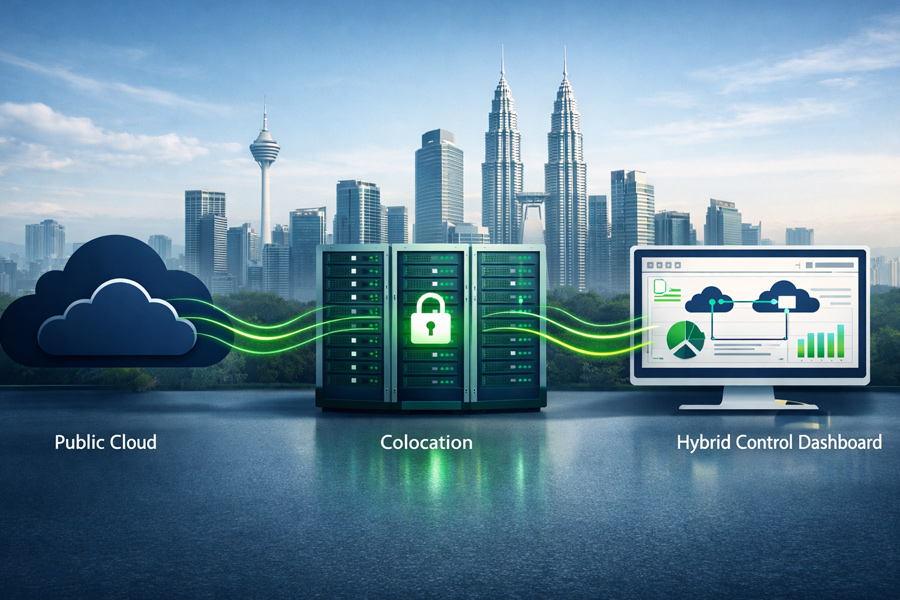
Cloud vs Colocation vs Hybrid, How to Choose the Right Setup
“The best infrastructure decision is rarely the most fashionable one. It is the one that fits your business best.“
For years, many businesses treated cloud as the automatic answer to digital transformation.
In 2026, that thinking is changing.
More business leaders are now asking a better question: Which workloads belong in cloud, which should stay under tighter control, and what setup gives the business the best balance of performance, resilience, flexibility, and cost?
That is why the conversation today is no longer just about cloud. It is about choosing the right mix.
JLL’s 2026 outlook says the global data center sector is being shaped by both cloud expansion and AI demand, with hyperscalers pursuing both leased and self-built capacity. Uptime Institute also says enterprises continue to adopt hybrid IT strategies across cloud, colocation, and on-premises data centers. In other words, the market itself is moving toward a blended decision model.
Source: JLL
What each model really means
Cloud
Cloud gives businesses speed, flexibility, and on-demand scalability. It is often a strong fit for changing workloads, rapid deployment, software development, collaboration tools, and services that benefit from fast provisioning.
Colocation
Colocation allows businesses to place their own hardware in a professionally managed data center environment. This is often attractive for organisations that want stronger control over hardware, performance, security, or data handling without maintaining their own server room.
Hybrid
Hybrid infrastructure combines both. Some systems remain in a secure colocation or private environment, while selected workloads connect to public cloud services. This model is becoming more important as businesses try to balance agility with control. Uptime explicitly describes hybrid IT as spanning cloud, colocation, and on-premises environments.
Source: Uptime Institute
Why businesses are rethinking “Cloud First”
Cloud is still important, but many businesses are becoming more careful about where cloud creates value and where it creates complexity.
That shift is being driven by several realities:
1. Cost visibility matters more now
As businesses scale, some workloads become expensive to run continuously in public cloud. This is one reason why workload placement is becoming a bigger strategic decision. Industry commentary around repatriation and hybrid design reflects that businesses are increasingly reviewing cost, control, and compliance together, rather than assuming every workload should stay in public cloud.
Source: Volico.com
2. Uptime and resilience remain critical
Uptime Institute says the industry is facing rising costs, worsening power constraints, and growing AI-related pressures. That means businesses need to think more carefully about the environment supporting their most important systems.
Source: Uptime Institute
3. Some workloads still need tighter control
Core business systems, sensitive data, latency-sensitive applications, and integrated operational platforms may need more predictable performance or more direct management than a pure cloud model provides. That is where colocation or a hybrid setup often becomes more practical.
Source: Uptime Institute
A simple way to choose the right setup
Here is a practical business view.
Cloud may be the right fit if:
-
- you need fast deployment
- your workloads change often
- you want to avoid upfront hardware investment
- your team values elasticity and rapid scaling
- your applications are already cloud-native
Colocation may be the right fit if:
-
- you want to keep control of your hardware
- you need stronger uptime and physical infrastructure discipline
- you are moving out of an office server room
- your core systems need stable performance
- you want a professional data center environment without building one yourself
BigBand describes its colocation model as giving businesses secure control with guaranteed uptime in ISO-certified, globally connected Tier III data centers, supported by physical security, precision cooling, and UPS-backed power.
Source: Bigband.net.my
Hybrid may be the right fit if:
-
- some workloads benefit from cloud, while others need tighter control
- you want to scale gradually instead of shifting everything at once
- you need better business continuity planning
- you want flexibility without giving up visibility and control
- you want to connect private infrastructure to cloud services in a more structured way
Why hybrid is becoming a stronger answer in 2026
For many businesses, hybrid is no longer a compromise. It is the most realistic model.
A business might keep critical databases, ERP systems, or sensitive internal applications in a secure colocation environment, while using cloud for backup, collaboration, burst capacity, analytics, or customer-facing digital services.
This reduces the pressure to make an “all or nothing” decision.
It also helps management teams think more clearly about ROI. Not every workload needs the same environment. The smarter question is: Which environment gives each workload the best business outcome?
This direction also matches what the broader market is doing. JLL says leased capacity, which includes colocation and build-to-suit facilities, is expected to add 62 GW between 2026 and 2030 to meet sustained cloud and AI demand. That is a strong signal that colocation remains highly relevant even in a cloud-led market.
Source: bytemag.ru
BigBand’s advisory view
At BigBand, we do not believe businesses should choose infrastructure based on trend alone.
The right choice depends on what you are running, how critical it is, how much control you need, what your growth plan looks like, and how much operational risk you are willing to carry.
Some businesses should move faster into cloud.
Some should strengthen their colocation setup.
Many will get the best result from a hybrid model.
BigBand’s role is to help businesses evaluate that decision in business language, not just technical language. Through its cloud, colocation, connectivity, cybersecurity, and continuity services, BigBand positions itself as a local digital infrastructure partner built for uptime, control, and long-term resilience.
Source: BigBand
A quick management checklist
Before choosing cloud, colocation, or hybrid, ask:
-
- Which systems cannot afford downtime?
- Which workloads need tighter control or predictable performance?
- Which services really benefit from cloud elasticity?
- Are we trying to reduce CapEx, reduce risk, or improve operational resilience?
- Is our current environment helping growth, or quietly limiting it?
Final thought
In 2026, the right infrastructure strategy is not about choosing sides.
It is about choosing what works.
Cloud, colocation, and hybrid all have value. The smart decision comes from matching each model to the needs of the business, not forcing the business to fit the model.
If you are reviewing your current infrastructure strategy, BigBand can help you assess whether cloud, colocation, or a hybrid setup is the right fit for your business performance, continuity, and growth goals.