
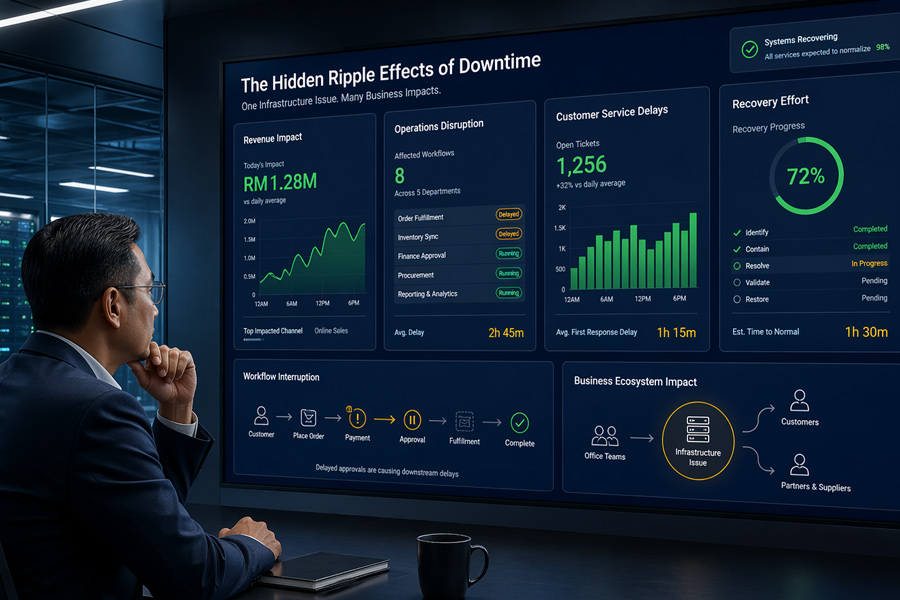
The Hidden Cost of Downtime, What Management Teams Often Miss
“Downtime is rarely just an IT interruption. It is often a business interruption with financial, operational, and reputational consequences.“
When systems go down, many management teams first ask one question:
How long were we offline?
It is an understandable question, but often the wrong one.
The bigger issue is not only how long the outage lasted. The bigger issue is what the outage disrupted, what it delayed, what it damaged, and what it cost the business after systems came back. Uptime Institute’s latest analysis shows that outages remain expensive, with more than half of respondents saying their most recent significant outage cost over USD 100,000, and one in five saying it cost more than USD 1 million.
Source: Uptime Institute
Why downtime is more expensive than many teams realise
Downtime is often underestimated because the visible failure is only one part of the story.
The real cost usually appears across several layers of the business:
1. Revenue disruption
If sales systems, payment platforms, ordering portals, customer service systems, or operational workflows go offline, revenue can slow immediately. Even short interruptions can affect order flow, service delivery, and customer response times. IBM notes that poor resilience increases exposure to downtime, financial penalties, and business damage.
2. Productivity loss
When core systems are unavailable, staff do not simply “wait.” Work piles up. Manual workarounds begin. Teams repeat tasks, delay approvals, and spend hours catching up after recovery. The outage clock may stop, but internal disruption often continues much longer.
3. Recovery and incident response costs
The effort to restore systems, investigate the root cause, validate data integrity, communicate internally, and reassure customers can become a major hidden cost. IBM highlights that effective resilience requires tested response plans, clear roles, and crisis simulations because the impact of incidents extends beyond the initial event.
4. Customer trust and business reputation
An outage can affect how customers, partners, and stakeholders view the business. If service becomes unreliable, confidence drops. In some sectors, that trust is difficult to win back. IBM specifically warns that weak business continuity and disaster recovery planning can lead to reputational damage and customer loss.
5. Leadership distraction
One of the least discussed costs of downtime is management attention. During and after an outage, leadership teams are pulled into escalation, explanation, and recovery decisions. Time that should be spent on growth, strategy, or customer development is spent containing operational disruption.
Why this matters more in 2026
Infrastructure risk is becoming more important, not less.
JLL’s 2026 outlook says global data center capacity is expected to grow from 103 GW to 200 GW by 2030, while AI workloads and power constraints are reshaping infrastructure planning. Uptime Institute also continues to warn that the complexity of modern architectures and evolving external threats create new outage risks. In simple terms, businesses are becoming more digital at the same time that infrastructure demands are becoming harder to manage well.
That is why management teams should not look at downtime as a rare technical inconvenience. They should treat it as an operational and financial risk category.
Source: JLL
The common mistake many businesses make
Many businesses still run important workloads in environments that were never built for true resilience.
This often includes:
-
- Office server rooms
- Limited UPS coverage
- Non-redundant cooling
- Basic physical access control
- Internet links without proper failover
- Environments that depend too heavily on one internal team
These setups may appear cost-effective on paper, but they often shift risk quietly into the future. The monthly savings can disappear very quickly if a single outage causes disruption across finance, sales, operations, and customer service.
What management teams should really ask
Instead of only asking, “How long can we afford to be down?”, ask:
-
- Which systems cannot stop without affecting revenue or operations?
- If one outage happens, what is the real business cost across people, customers, and recovery effort?
- Are we relying on a room, setup, or process that was never designed for business continuity?
- Does our current environment support growth, or increase hidden operational risk?
- If customers or auditors reviewed our infrastructure setup today, would we feel confident?
These questions lead to better decisions than simply comparing monthly IT costs.
Where colocation enters the picture
Colocation is not only about renting rack space.
For many businesses, it is a practical way to reduce the hidden cost of downtime by moving critical hardware into a professionally managed environment built for uptime, power resilience, cooling discipline, connectivity, and physical security.
BigBand’s published colocation positioning is built around exactly these concerns: Tier III data center infrastructure, 99.982% uptime, physical security, precision cooling, UPS-backed power, and local operational support.
Source: bigband.net.my
This does not mean every workload must move to colocation. It means that businesses with critical systems should seriously assess whether their current environment is strong enough for the level of operational continuity they actually need.
BigBand’s advisory view
At BigBand, we believe the most dangerous infrastructure cost is often the one that does not appear clearly in a monthly report.
A business may feel it is saving money by keeping systems in an office server room or by delaying infrastructure upgrades. But if that setup increases outage risk, recovery difficulty, or customer disruption, the real cost may already be higher than expected.
That is why infrastructure planning should be tied to business continuity, risk protection, and management confidence, not just short-term cost comparison.
BigBand’s role is to help businesses review these trade-offs in practical terms, then identify whether colocation, cloud, or a hybrid model makes better sense for long-term resilience and growth.
Source: BigBand
Final thought
Downtime is rarely just about “minutes lost.”
It affects revenue, staff productivity, customer trust, leadership focus, and recovery cost. In 2026, the businesses that handle downtime risk best will not be the ones that react fastest only after something breaks. They will be the ones that designed a stronger environment before the outage happened.