
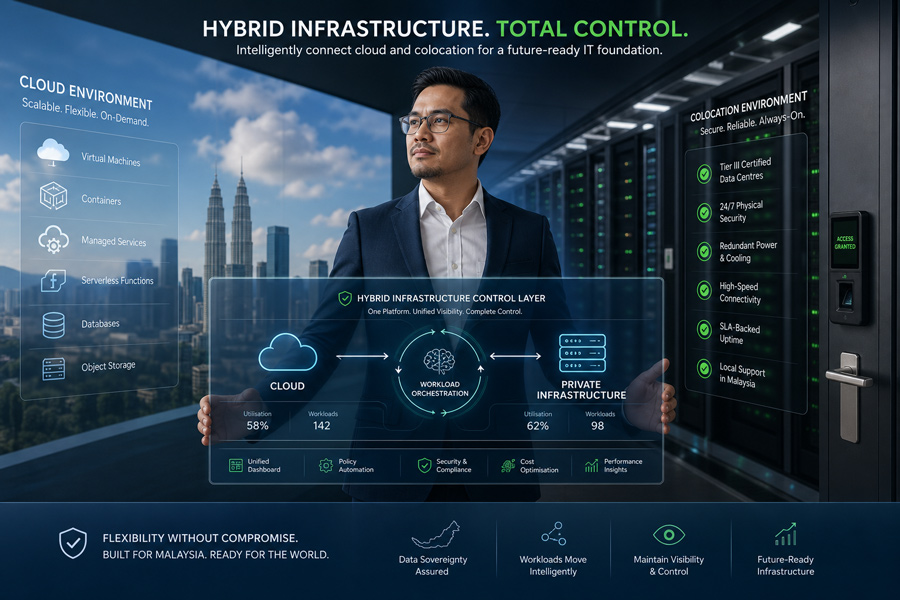
How Colocation Supports Hybrid Cloud Without Losing Control
“Hybrid cloud works best when flexibility grows, but control does not disappear.”
For many businesses, cloud adoption started with a simple promise: more flexibility, faster deployment, and less hardware burden.
That promise still matters.
But in 2026, many organisations are asking a more mature question:
How do we use cloud where it makes sense, without losing too much control over critical systems, data placement, performance, and long-term infrastructure direction?
That is where colocation becomes important.
Uptime Institute says enterprises continue to adopt hybrid IT strategies that span cloud, colocation, and on-premises environments. Equinix also positions colocation as a foundation for hybrid environments by enabling private infrastructure, multicloud access, and tighter control over data placement.
Source: Uptime Institute , EQUINIX
Why hybrid cloud is becoming the practical model
The market is moving beyond “cloud only” thinking.
JLL says hyperscalers are pursuing both leased and self-built capacity, while Uptime Institute notes that hybrid IT remains a core enterprise direction. That tells us something important: even in a cloud-led era, businesses still need private infrastructure, operational control, and workload placement discipline.
Source: Uptime Institute News
For management teams, this means the real decision is no longer:
Should we go to cloud or not?
It is now:
Which workloads belong in cloud, which need stronger control, and how do we connect both environments well?
Where colocation fits in a hybrid strategy
Colocation helps hybrid cloud work by giving businesses a professional environment for the systems they do not want to place fully in public cloud.
That usually includes:
-
- Core databases
- ERP platforms
- Finance systems
- Latency-sensitive applications
- Regulated or location-sensitive workloads
- Infrastructure that needs more stable long-term cost planning
Equinix describes colocation and connectivity as supporting hybrid environments with multicloud access, locality control, and private infrastructure. It also says businesses can retain control over data placement to meet regulatory and compliance needs across public, private, and hybrid cloud environments.
Source: EQUINIX , EQUINIX – Connectivity
Why businesses worry about “losing control”
Cloud brings real advantages, but some concerns keep returning as organisations mature:
1. Data placement and sovereignty
Some businesses want clearer visibility over where data lives and how it is handled. Equinix explicitly links hybrid infrastructure to data placement control and compliance support. BigBand’s private cloud positioning also emphasizes regional compliance and data sovereignty in Malaysia and Southeast Asia.
Source: EQUINIX
2. Performance predictability
Not every workload behaves well in a fully shared or remote public cloud environment. Some applications need more predictable performance, lower latency, or tighter infrastructure tuning. Equinix says private infrastructure supports applications that cannot run effectively in the cloud.
Source: EQUINIX – Data Centre
3. Long-term cost discipline
For stable, high-utilisation workloads, businesses often want more control over long-term infrastructure economics. BigBand’s recent hybrid and colocation content specifically advises Malaysian businesses to compare five-year total cost for consistently utilised workloads across public cloud, private cloud, and colocation.
Source: BigBand Insights
4. Strategic visibility
Some teams become uncomfortable when critical systems are spread across environments without a clear architecture plan. Hybrid works best when it is intentional, not accidental. Uptime Institute’s ongoing emphasis on hybrid IT reflects that modern enterprises need structured workload placement, not just fragmented infrastructure decisions.
Source: Uptime Institue News
What colocation gives hybrid cloud
A good colocation environment can give hybrid cloud four important strengths.
First, a private anchor for critical systems
Instead of placing everything in public cloud, businesses can keep selected systems in a professionally managed private environment while still connecting to cloud services as needed. Equinix frames this as private infrastructure combined with multicloud access.
Source: EQUINIX
Second, more intentional workload placement
Hybrid becomes easier to manage when workloads are placed by purpose. BigBand’s recent article describes colocation as a hybrid hub that lets Malaysian businesses choose the right infrastructure for each workload.
Source: bigband.net.my
Third, stronger control over business-critical environments
Colocation allows businesses to maintain direct control over hardware, infrastructure design, and surrounding operating discipline. BigBand publicly positions its colocation services around secure control, Tier III infrastructure, and guaranteed uptime.
Source: bigband.net.my
Fourth, a better bridge between continuity and flexibility
Hybrid cloud is often attractive because it lets businesses use cloud for agility while keeping critical environments in a more controlled setting. This balance is one of the clearest reasons hybrid remains strong in enterprise infrastructure strategy.
Source: Uptime Institue
Why this matters to Malaysian businesses
For Malaysian SMEs, corporates, and organisations, hybrid cloud can be a very practical model.
A business might want:
-
- Cloud for collaboration and scalability
- Private infrastructure for sensitive data
- Local hosting for continuity planning
- More control over core systems without losing flexibility
BigBand’s public service portfolio is well aligned to this model. It offers public cloud, private cloud, storage cloud, GPU cloud, colocation, connectivity, cybersecurity, and continuity-oriented infrastructure services, which supports the idea that businesses do not need to be forced into one model only.
Source: BigBand Insights , BigBand – Private Cloud , BigBand – Storage Cloud , BigBand – GPU Cloud
Why this matters to Chinese and regional businesses
For Chinese-speaking companies, manufacturers, and businesses entering Malaysia or ASEAN, hybrid cloud with colocation can also reduce uncertainty.
It allows a business to build a more controlled local infrastructure base while still connecting to cloud tools and services where needed. That can be valuable for firms that want local presence, clearer data handling, and stronger operational confidence as they expand regionally. BigBand’s public materials emphasize Malaysia and Southeast Asia support, local data hosting options, and infrastructure control, which fit this audience well.
Source: bigband.net.my
Where BigBand fits
BigBand’s own recent content already expresses this clearly: colocation can function as a hybrid hub, helping businesses choose the right environment for each workload instead of forcing everything into one model. BigBand also presents itself as offering the full infrastructure spectrum, including public cloud, private cloud, and colocation, so the recommendation can be based on business fit rather than product limitation.
Source: bigband.net.my
Its broader service positioning also highlights secure control, Tier III uptime, data sovereignty support, and integrated cloud and infrastructure services for Malaysian and regional businesses.
Source: bigband.net.my
BigBand’s advisory view
At BigBand, we believe hybrid cloud should not mean fragmented infrastructure.
It should mean better workload decisions.
Some systems belong in cloud for speed and flexibility. Some should remain in a more controlled environment for continuity, compliance, performance, or strategic visibility. Colocation helps create that balance.
That is why colocation still matters in a cloud-led world. It is not resisting cloud. It is helping cloud strategy become more practical, more disciplined, and more business-aligned. This fits BigBand’s positioning as a digital infrastructure advisory partner for growth and risk protection.
Source: bigband.net.my
Final thought
Hybrid cloud works best when it combines the right strengths from both worlds.
Cloud gives flexibility.
Colocation helps preserve control.
For many businesses in 2026, that combination is not a compromise. It is the smarter infrastructure model.
If your business is reviewing how to balance cloud flexibility with infrastructure control, BigBand can help you assess whether a colocation-led hybrid model, public cloud setup, or broader mixed environment is the better fit for your continuity, compliance, and growth goals. BigBand’s public materials already position colocation as a practical hybrid hub for Malaysian businesses.